What the Coating Line Doesn’t Tell You. Read the article
What the Coating Line Doesn’t Tell You. Read the article
At-line and lab characterization of flat samples. A full multi-property profile in seconds. Built for quality labs, product development, R&D and incoming inspection.
PlasmaSens Standalone characterizes samples and coupons at the surface and below it. One non-destructive scan returns signal maps and anomaly flags, plus property values once models are calibrated with your reference measurements, so your team can compare materials, run a full characterization and get to the root cause when something goes wrong.
Explore material response and process behavior in a controlled setting.
Support incoming inspection, R&D and qualification workflows.
Shorten development cycles and screening time.
Reveal richer plasma-material signals for better decisions.
Analysis Examples
PlasmaSens Standalone sits at-line and in the lab, wherever teams need a detailed look at a sample: process and product development, failure and root cause analysis, incoming inspection, quality checks and more. Here is one example of what a single scan shows.
When you change a formulation or a process, you need to know what it did to the material. Standalone takes high-resolution 2D scans of a sample and maps how uniform it is, where defects sit, and how properties vary, so trials can be compared side by side.
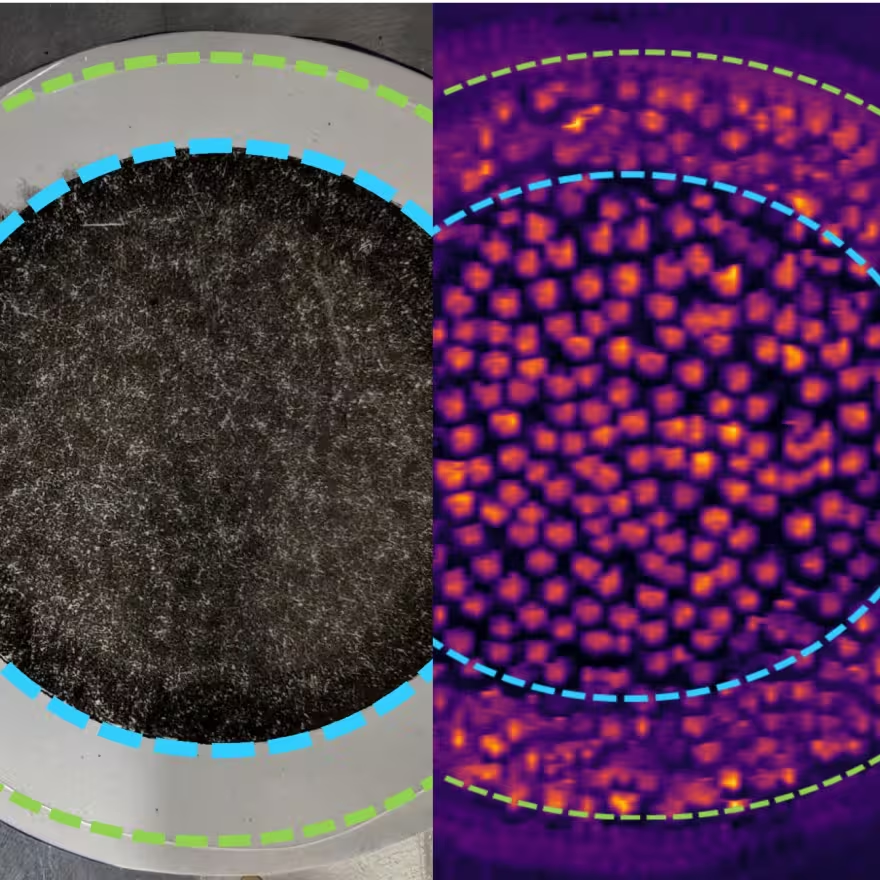
Active material across a membrane sample, mapped with PlasmaSens Standalone. Bright areas hold more active material.
01
See how uniform a sample is
Applications
At-line characterization for the industries where coatings, films and layered materials decide quality.
Explore Applications
Reads the coatings and functional layers in turbines, fuel cells and solar cells, where thickness, bonding and uniformity decide life and efficiency.

Characterizes hardened alloys, coatings, welds and joins on flight-critical parts.

Measures mass loading, porosity, resistivity, metal contamination and more on battery electrodes.

Characterizes thin films, coatings, and crystalline substrates that determine yield and performance.


No. PlasmaSens uses a very low-energy cold atmospheric plasma, generated using 1 to 1.5 watts and emitted at about 40 °C. PlasmaSens is non-contact, needs no sample preparation and works in ambient conditions. We work with customers during the sample intake process to ensure we mutually agree on demo targets and operating parameters that are tuned to specific customer material targets.
As few as five samples can be sufficient for a successful demonstration, ideally with reference measurements for the properties or defects you care about so we can build models that will report or identify them. We scan them and send a preliminary report. If you don’t have reference data for your samples, unsupervised analysis and signal maps can still reveal and visualize meaningful information about your samples.
Flat samples from 50 × 50 mm up to 200 × 162 mm. They can be conductive, semiconductive or insulating.
About 30 cm² per minute at standard settings. Once a data baseline is established, the system can be tuned to provide faster scans or higher resolution scans as required. Once a model is calibrated, property values are ready in seconds to minutes after the scan.
Documents
Enter your details and we will email you the product brochure.